Overview
People either maintain mental ledgers, scroll through old chats, or install third-party apps that most groups abandon after a single use. Payment apps attempt to solve this, but they fragment users across platforms and fail to address the core problem: shared tracking.
As a result, money remains unsettled, follow-ups feel socially awkward, and trust issues build within groups.
This case study examines how WhatsApp can address this issue by introducing native, platform-agnostic expense tracking directly within group chats, transforming conversations into a coordination infrastructure.
Problem Discovery
What's broken today?
Users struggle to track and settle group expenses because:
- Existing solutions require installing third-party apps like Splitwise, which most people resist installing — especially for short-term use.
- Payment apps like Google Pay, PhonePe, and Paytm offer a split option, but they require everyone to be on the same platform.
- Manual tracking in chat is error-prone and easily forgotten. Conversations move fast, and expense messages get buried.
- Follow-ups feel awkward and are often avoided.
Users don't fail to settle expenses because payments are hard. They fail because coordination is messy.
The problem is not transferring money. The problem is tracking shared responsibility.
Key Insight
Goals
User Goals
- Log shared expenses in under a minute.
- Maintain a single source of truth for group balances.
- Reduce social friction in settlements.
- Enable transparent, real-time payment status.
Business Goals
- Increase WhatsApp group utility beyond messaging.
- Drive incremental adoption of WhatsApp Pay.
- Improve group retention and session depth.
- Position WhatsApp as an infrastructure layer for real-world coordination.
Target Users
Primary Users
College students and friend groups (trips, food, rent) represent the highest-frequency use case. These users split expenses almost daily, often in small amounts, and value speed above all else. They are also the most resistant to installing standalone apps for short-lived groups.
Secondary Users
Flatmates, families, and small teams have lower frequency but higher stakes per transaction. Recurring expenses (rent, utilities, groceries) and longer group lifespans mean they need persistent, auditable ledgers more than speed.
Product Hypothesis
User Personas
| Priya (College Student) | Arjun (Young Professional) | Meera (PG Roommate) |
|---|---|---|
| As a student, I want to split my friends' canteen bills so that everyone pays their fair share immediately. | As someone planning group trips, I want to log multiple expenses over time, so we can settle up in one go at the end. | As a PG roommate, I want to split monthly house bills with the roommates, so recurring payments are managed easily. |
| As a member of multiple groups, I want to track which expense requests are still pending from me, so that I don't forget and cause friction. | As a payer, I want to pay directly via WhatsApp without copying UPI IDs, so that the process is instant. | I want to see when roommates pay, so I don't have to chase them manually. |
| Priority: Speed. She needs to log and move on in under 10 seconds. | Priority: Aggregation. He needs net settlement across 8–10 expenses. | Priority: Visibility. She needs an always-on ledger for recurring costs. |
User Stories
- As a college student splitting daily meals, I want to log an expense in under 15 seconds so I don't lose context in chat.
- As a trip organiser managing 8–10 expenses, I want to see net settlement so I don't manually reconcile 20 transfers.
- As someone who paid externally via UPI, I want to confirm payment without WhatsApp assuming transaction authority.
- As a flatmate, I want a transparent ledger so disputes are minimised.
- As a user in multiple groups, I want to quickly see where I owe money.
Solution Overview
A lightweight, chat-native group expense tracker inside WhatsApp that allows users to:
- Add shared expenses
- See real-time balances
- Settle via any UPI app
- Send gentle reminders
All without leaving the group chat.
🛠️ Live Proof of Concept: To demonstrate the technical feasibility and user flow of this native experience, I have built a live-coded MVP. You can interact with the working implementation here: Prototype Live Platform [clone of whatsapp with the split expense feature]
MVP Scope
Users can:
- Add expense
- Split equally / unequally / percentage
- View real-time balances
- Settle via:
- WhatsApp Pay (auto-confirm)
- Other UPI apps (user-confirm)
- Cash / manual (user-confirm)
- Send targeted reminders
- View net settlement in the Expense Hub
End-to-End User Journey
Expenses follow a clear lifecycle:
Create Expense → Pending State → Reminder Phase → Settlement → Closed
- Expenses are created inside the group chat.
- The expense remains in a pending state until all dues are cleared.
- Participants can settle individually or via net settlement.
- The expense is marked settled once all splits are cleared.
Expense Lifecycle
Detailed User Flows
1) Add Expense Flow
Entry Point. Group Chat → Attachment (+) → Expenses → Add Expense
User Journey
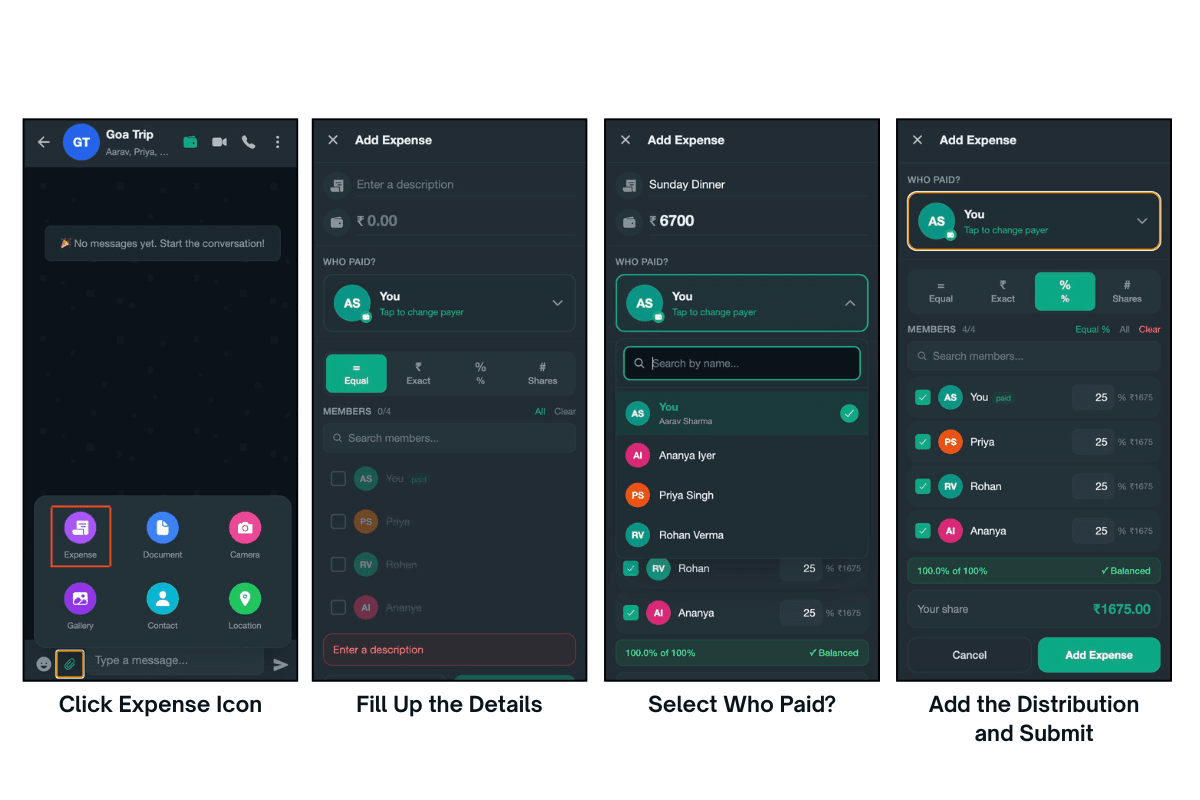
System Behaviour
- Validate amount and participant count.
- Create immutable expense record.
- Calculate individual splits.
- Update group balances.
- Post event message in chat.
Constraints and Rules
- Expense must have at least two participants.
- Split values must equal total amount.
- Amount must be greater than zero.
- Offline actions are queued.
- Expense records are append-only.
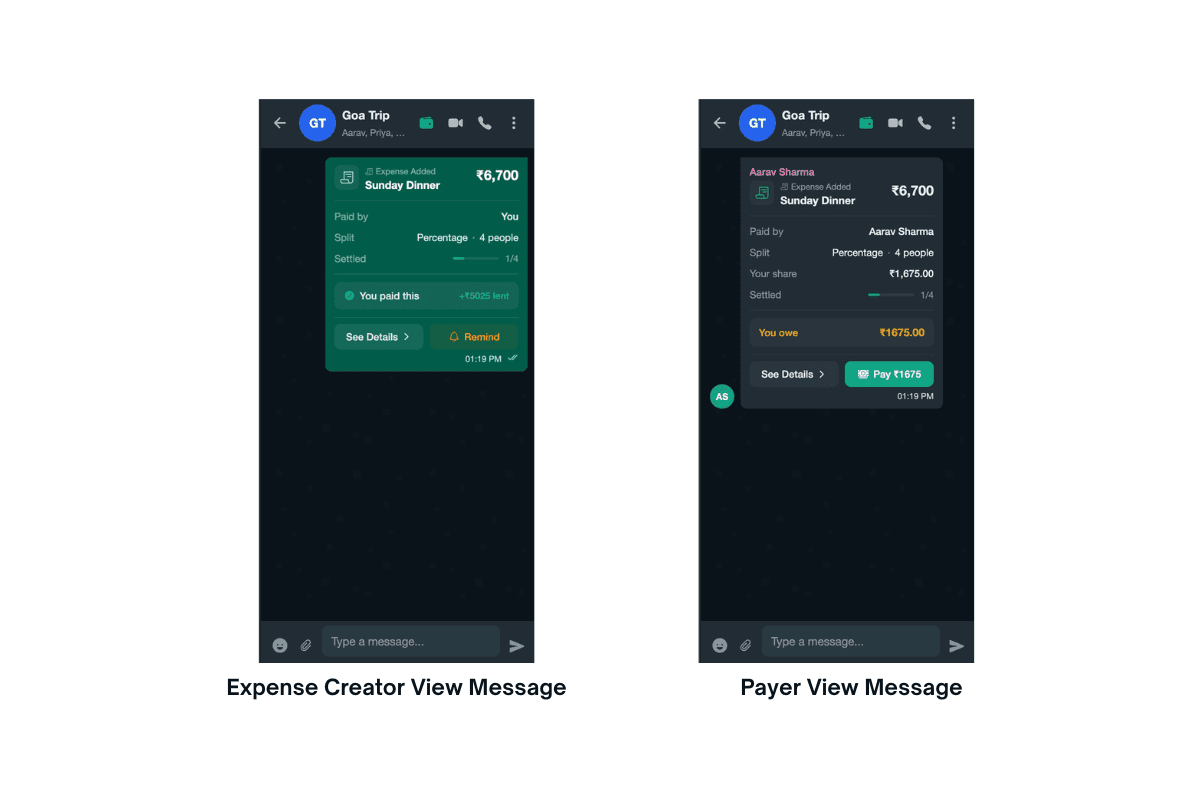
2) Pending Phase
Expense remains PENDING until all dues are cleared. During this phase:
- Participants may initiate payment.
- Creator may send reminders.
- Ledger is visible to the group.
3) Reminder Flow
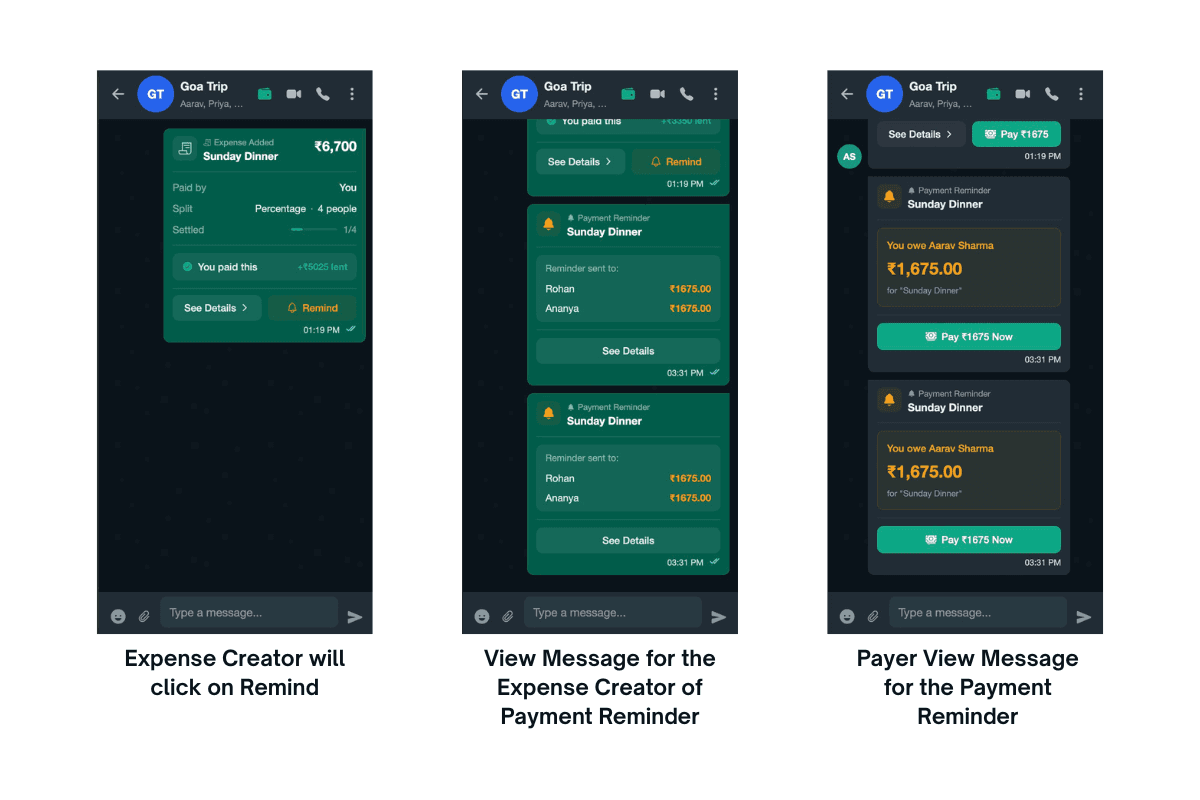
Constraints and Rules
- Only the expense creator can trigger a reminder.
- Sent only to
OWESusers. Paid members receive nothing. - Frequency capped: 1 per 24 hours, max 3 per expense.
- Disabled once settled.
- Reminders do not change financial state.
4) Expense Detail & Settlement Flow
Entry Points
- Group Chat → tap expense message → View Details
- Expense Hub → select specific expense
User Journey
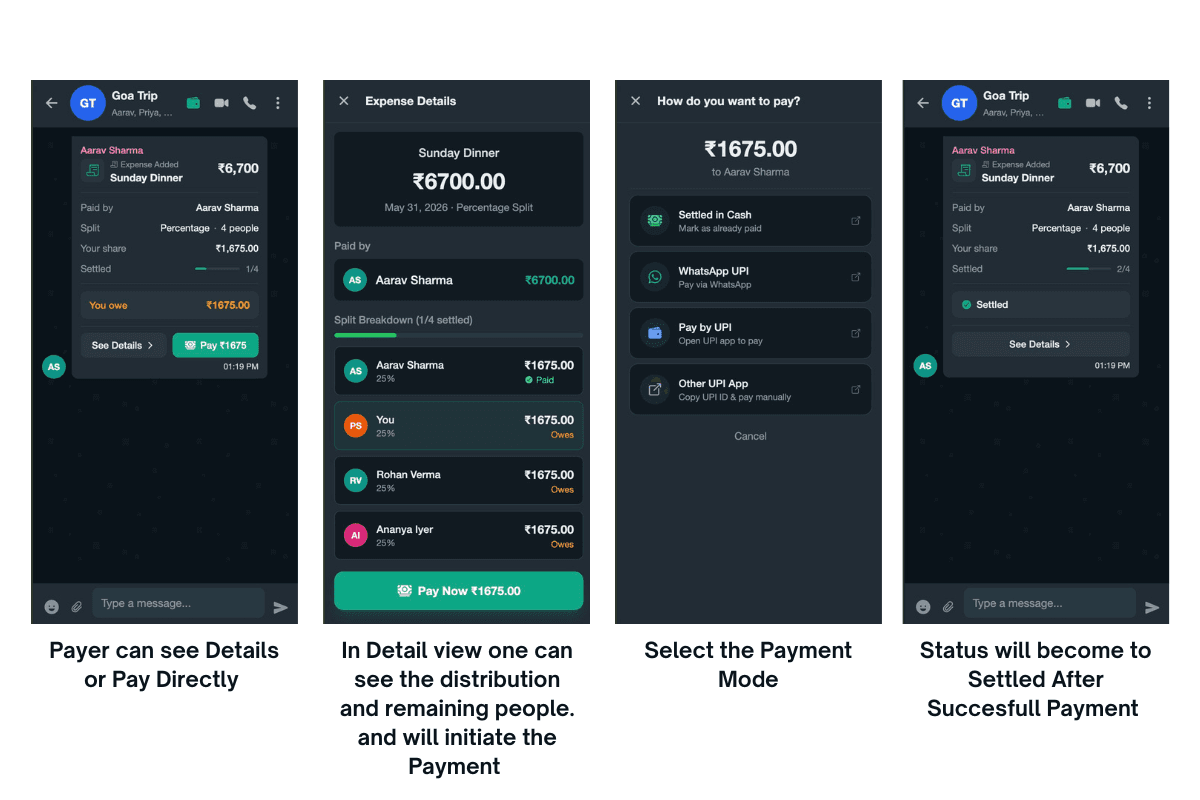
System Behaviour
- Display expense details and participant-level settlement status.
- Process payment based on selected method.
- Automatically confirm settlement for WhatsApp Pay transactions.
- Require manual confirmation for external or offline payments.
- Create settlement record and update expense ledger.
- Recalculate group balances in real time.
- Post settlement event message in group chat.
Constraints and Rules
- Settlement confirmation is trust-based.
- Partial payments are not supported in MVP.
- External payments require manual confirmation.
- Settlement updates are irreversible once confirmed.
5) Expense Hub (Net Settlement) Flow
Entry Points. Group Info → Expense Hub → Net Balances (default view) or All Expenses (secondary view).
80% of users want quick settlement. 20% want an audit trail. Both needs should be satisfied.
User Journey
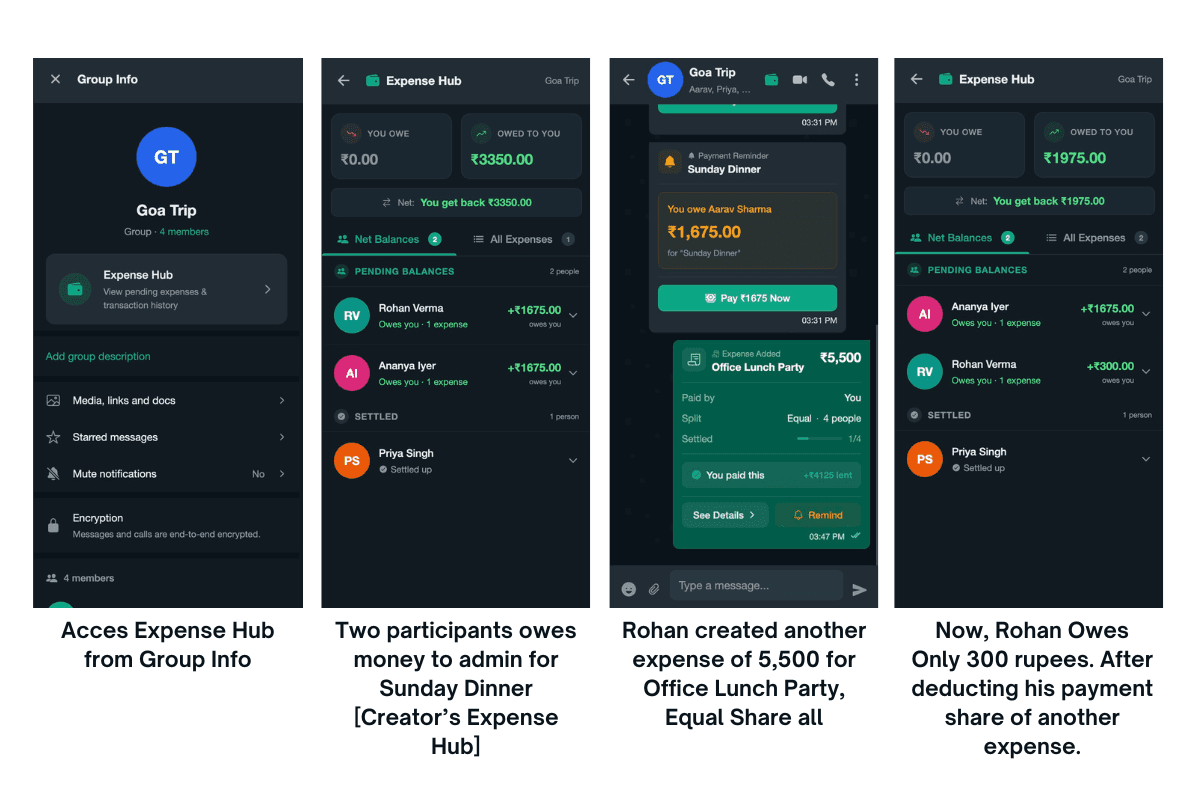
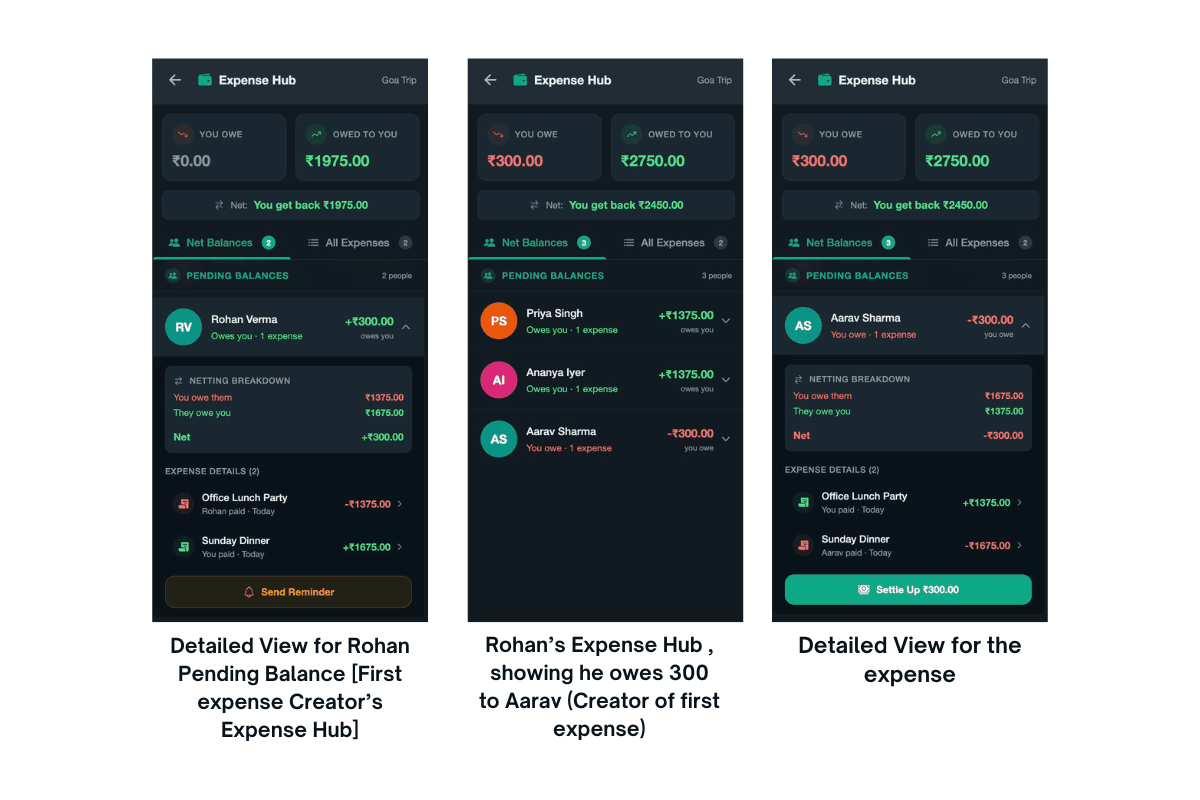
Net Balances View (Default)
Shows person-wise net balances for fast settlement.
- Summary header (total owed / receivable)
- Participant list with net balances
- Expandable expense breakdown
- Settlement action per person
Balance States
| State | Meaning |
|---|---|
| You owe | Liability (red) |
| You are owed | Receivable (green) |
| Settled | No pending balance |
Bidirectional Netting Model
The system maintains a user-to-user ledger.
Example:
- Abhishek pays ₹1000 for Devesh.
- Later Devesh pays ₹2500 for Abhishek.
- System computes net → Abhishek owes Devesh ₹1500.
Users always see final net positions.
Design Principles
- Net balance first.
- Minimal mental calculation.
- Transparent ledger.
- Fast settlement actions.
Constraints and Rules
- Net settlement may resolve multiple expense records.
- Settlement confirmation follows the same payment rules as individual expense settlement.
- All balance updates are dynamically recalculated.
- Settlement actions are visible to all group members.
Edge Cases & Failure Modes
A feature handling financial data for 500M+ Indian users needs explicit handling of boundary conditions.
| Scenario | System Behaviour | Rationale |
|---|---|---|
| Member leaves group with unsettled balance | Balance freezes. Remaining members see "Left group: ₹X unsettled." No auto-forgiveness. | Prevents silent debt erasure. Creator can mark as settled manually if needed. |
| Large group (50+) where only 4 shared a meal | Participant selector defaults to all but allows manual selection. Recently selected subgroups are suggested. | Reduces tap count for repeat subgroup splits without cluttering the main flow. |
| Two users disagree on whether payment was made | Settlement requires confirmation by both payer and receiver. Disputed settlements are flagged in the ledger. | Trust-based model needs a dispute surface. Transparent ledger serves as evidence. |
| User adds expense with wrong amount | Expenses are append-only. Creator can "cancel" (reversal entry) within 24 hours. Original record retained. | Immutability protects audit trail while allowing human error correction. |
| Offline user receives expense split | Actions queued. Expense visible on reconnect. No silent failures. | WhatsApp's existing offline-first architecture handles this natively. |
| Rounding errors in equal split (e.g., ₹100 among 3) | Remainder paisa assigned to the person who paid. Splits show exact amounts. | Ensures totals always add up. Payer absorbs trivial rounding difference. |
Out of Scope for MVP (Explicit)
- Multi-currency support for international groups (deferred to v2).
- Partial payments (full split amount only in MVP).
- Recurring / scheduled expenses.
- Cross-group balance aggregation.
Competitive Landscape
WhatsApp differentiates by solving coordination where users already communicate, removing installation and platform friction.
| Product | Core Limitation | Strengths WhatsApp Lacks | Why Users Still Choose WhatsApp |
|---|---|---|---|
| Splitwise | Requires separate app install. Adoption drops for short-term groups. | Expense categories, recurring splits, group simplification algorithm, IOUs across groups. | 100% group overlap. Zero onboarding friction. No one needs to download anything. |
| Google Pay | Platform-specific. Split feature requires all users on GPay. | Native UPI integration, transaction verification, merchant payments. | WhatsApp doesn't force a payment platform. Tracking works even if people pay via cash. |
| PhonePe / Paytm | Same platform lock-in. Split features are buried in UX. | Deep UPI ecosystem, cashback incentives, bill payments. | WhatsApp is the coordination layer. Users can pay with any app and confirm here. |
| Telegram / iMessage | No native expense features. Low penetration in India. | Telegram bots enable custom workflows. | WhatsApp owns 95%+ of Indian group messaging. Distribution is the moat. |
Competitive Positioning
The risk is power users who need Splitwise-level features. The mitigation is clear: WhatsApp solves the coordination layer. Power users can continue using Splitwise for advanced tracking while settling via WhatsApp.
Privacy & Safety
A feature that tracks financial obligations between friends operates in a high-trust, high-sensitivity context. The design must protect users without creating friction.
Data Scoping & Storage
- Expense data is strictly group-scoped. No data is shared outside participants.
- Expense metadata (amounts, splits, settlement status) is stored on WhatsApp servers to enable cross-device sync, consistent with how group messages are handled.
- End-to-end encryption applies to expense messages within the chat. Ledger data follows WhatsApp's existing encryption model for group metadata.
Payment Privacy
- External payments (Google Pay, PhonePe, cash) are not tracked or verified by WhatsApp. Only the user's self-reported confirmation is recorded.
- WhatsApp Pay transactions follow existing UPI / NPCI compliance requirements.
- No payment method is forced. The system is agnostic.
Social Safety
- Reminders are capped (1 / day, 3 / expense) to prevent harassment.
- Settlement amounts are visible to all group members for transparency, but individual payment method choice is private.
- Users retain full control over marking payments. No automated debt enforcement.
Regulatory Considerations
- The feature tracks obligations between users, not financial transactions. This positions it as a ledger / record-keeping tool rather than a payment instrument, avoiding PSP / PPI licensing requirements under RBI.
- WhatsApp Pay integration follows existing NPCI approvals and transaction limits.
- Legal review required before launch to confirm ledger data does not trigger financial data localisation obligations beyond what WhatsApp already complies with.
UX Principles
- Zero install friction.
- Minimal input steps.
- Clear and transparent balances.
- No forced financial behaviour.
- Avoid awkward social nudges.
Success Metrics
The success of the feature is measured across three layers: core user value (North Star), product adoption & engagement drivers, and business impact for WhatsApp.
1. North Star Metric — Core User Value
| Metric | Description | Why it matters |
|---|---|---|
| % of group expenses successfully settled | Percentage of created expenses that are fully settled by all participants. | Measures whether the product solves the core problem of group expense coordination. Higher settlement indicates real user value and trust in the system. |
2. Product Adoption & Engagement
| Metric | Description | Signal |
|---|---|---|
| Activation Rate | % of WhatsApp groups that create at least one expense. | Feature discovery and initial adoption. |
| Expense Creation Frequency | Average number of expenses created per group per week. | Ongoing usage and habit formation. |
| Settlement Rate | Percentage of expenses settled within X days. | Efficiency of coordination. |
| Group Retention (D30) | % of groups using the feature after 30 days. | Long-term product value. |
3. Business Impact Metrics (WhatsApp)
| Metric | Description | Business Impact |
|---|---|---|
| Session Depth | Average actions performed per group session. | Higher engagement within WhatsApp. |
| WhatsApp Pay Adoption | Number of first-time payments via WhatsApp Pay from expense flows. | Payments ecosystem growth. |
| Retention Lift | Increase in group retention vs control groups. | Platform stickiness. |
| Group Activity Growth | Increase in group message or interaction frequency. | Coordination platform positioning. |
Non-Goals
- Acting as a wallet.
- Forcing WhatsApp Pay usage.
- Merchant payments.
- Advanced accounting features.
Risks & Mitigations
| Risk | Likelihood | Mitigation | Monitoring Signal |
|---|---|---|---|
| Low adoption — users don't discover or try the feature | High | Gradual onboarding via contextual prompts when money-related messages are detected in groups. | Activation rate < 5% of eligible groups after 30 days. |
| Reminder fatigue — users feel harassed by payment nudges | Medium | Frequency limits (1 / day, 3 / expense). Tone is neutral, not guilt-inducing. | Reminder mute rate > 40% or group exit spikes after reminders. |
| Settlement disputes — users disagree on whether payment was made | Medium | Transparent balances visible to all. Dual confirmation for external payments. | Support tickets related to disputed settlements > 2% of total settlements. |
| Privacy backlash — users uncomfortable with financial data in WhatsApp | Low–Medium | Group-only visibility. No cross-group aggregation. Clear privacy disclosures at first use. | Feature opt-out or group admin disable rate > 10%. |
| Abuse potential — fake expenses created to pressure members | Low | Any group member can flag / dispute an expense. Admin can delete expenses. | Expense flagging / dispute rate > 5% of total expenses. |
| Cannibalisation — feature reduces WhatsApp Pay settlement by enabling external payments | Low | WhatsApp Pay is surfaced as the default (first) payment option. Tracking drives payment awareness even if users pay externally. | WhatsApp Pay share of settlements < 15% after 90 days. |
Rollout & Experimentation Plan
Given the financial sensitivity and scale of WhatsApp's user base, a phased rollout is critical.
Phase 1: Closed Beta (4 weeks)
- Audience: 5,000 groups in Tier 1 cities (Bangalore, Mumbai, Delhi). Skewed towards college-age users (18–25).
- Goal: Validate core flow completion rate (expense creation to settlement). Target: 60%+ of created expenses reach settlement within 7 days.
- Kill criteria: Settlement rate < 30%, or privacy-related group exits > 5%.
Phase 2: Controlled Rollout (6 weeks)
- Audience: 5% of Indian WhatsApp groups, randomised A/B test.
- Goal: Measure group retention lift, WhatsApp Pay adoption from expense flows, and session depth increase vs control.
- Minimum signal to proceed: Statistically significant D30 group retention lift > 2%, and activation rate > 8% of eligible groups.
Phase 3: General Availability
- India-first launch. International markets evaluated based on UPI / payment ecosystem maturity.
- Feature discovery via contextual prompts, WhatsApp Status tips, and group admin notifications.
Future Enhancements
- OCR bill scanning.
- Voice-based expense entry.
- Monthly summaries.
- Exportable reports.
- Recurring / scheduled expenses (addresses Meera's PG roommate use case).
- Multi-currency support for international groups.